

By Matte Kane, Union Representative
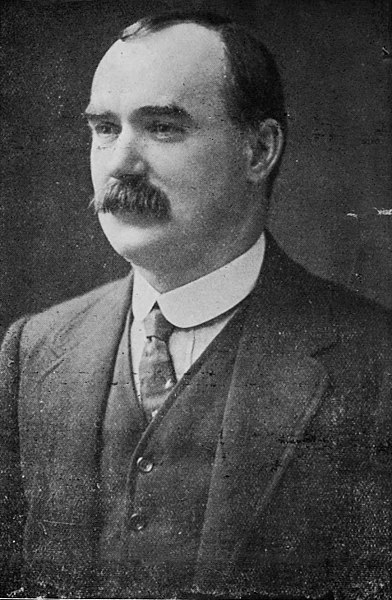
We often hear and use the term “working class hero,” yet few of us actually know who these heroes are, or what their legacy is that remains on society. As we head into this St. Patrick’s Day weekend, let us remember a true Irish/American Working Class Hero: James Connolly.
James Connolly, much like Ireland’s patron saint whom we celebrate every spring, was not born in Ireland, but rather in Edinburgh, Scotland in 1868. He was sentenced to death by firing squad on May 12, 1916 for his role in the Easter Rising of 1916 which lead to the formation of the Irish Republic and ultimately independence from Great Britain.
Born into abject poverty in Edinburgh’s Irish ghetto Cowgate, Connolly is not known to have attended school beyond the age of 11, when he began working many menial jobs to help support his family. Unemployment forced a young Connolly to enlist in British Army to serve in India. Seeing the effects of unbridled colonialism on the Indian population, he soon deserted and returned to Scotland where he became involved in the Scottish Socialist Federation (SSF) and campaigned throughout Edinburgh to establish an eight-hour work day. He ultimately rose to the position of Secretary of the SSF, which sadly did not pay enough to support his new wife Lillie and two children. Connolly was offered a paid position in Dublin as an organizer for the Irish Socialist Republican Party. The ISRP is regarded by many historians as a party of pivotal importance in the early history of Irish socialism and republicanism. After about 7 years of enlisting laborers to the ranks of the party and becoming increasingly frustrated by the lack of union involvement in party politics, Connolly – like many turn of the century Irish – fled to America in hopes of finding “streets paved in gold” and better opportunities for his family.
Settling in Troy, New York, Connolly began working a variety of factory jobs, many of which he would be terminated from for organizing workers to join The Industrial Workers of the World Union, before eventually dedicating himself to full time organizing in many parts of the country. His union activity was more of a passion and belief than a career, as he spiraled into poverty attempting to maintain employment while building the core of rank and file Unionism in America. Living in a tenement in New York, Connolly decided if he was to be poor, he would rather do it in Ireland where there was a greater need to improve workers’ rights and conditions. In 1910, Connolly and his family of now six children returned to Dublin.
On Connolly’s return to Ireland in 1910, he became right-hand man to fellow unionist James Larkin in The Irish Transportation and General Workers Union. His name, and those of his family, appears in the 1911 Census of Ireland, with his occupation listed as “National Organiser Socialist Party.” In 1913, in response to the “Lockout” of Irish workers being replaced by relocated workers from England, he – along with an ex-British officer Jack White – founded the Irish Citizens Army (ICA), an armed and well-trained body of labour men whose aim was to defend workers and strikers, particularly from the frequent brutality of the Dublin Metropolitan Police. Though they only numbered about 250 people at most, their goal soon became the establishment of an independent and socialist Irish nation. He also founded the Irish Labour Party as the political wing of the Irish Trade Union Congress in 1912, and was a member of its National Executive Board.
During the Easter Rising, beginning on 24 April 1916, Connolly was Commandant of the Dublin Brigade. Because the Dublin Brigade had the most substantial role in the rising, he was de facto commander of Irish Nationalist forces. Connolly’s leadership in the Easter Rising was considered formidable. Irish patriot Michael Collins said of Connolly that he “would have followed him through hell.”
Although he had written five books and hundreds of essays in his 48 years, the note (paraphrased below) he penned to his wife on the eve of his execution reveals the heart and soul of the man who dedicated his life to providing dignity to millions of low wage workers the world over:
“Oh Lillie, I don’t want to die, we’ve got so much to live for and I know we’re all going out to get slaughtered, but I just can’t take any more. Just the sight of one more child screaming from hunger in a Dublin slum or his mother slaving 14 hours a day for the scum. Who exploit her and take her youth and throw it on a factory floor. Oh Lillie, I just can’t take any more.
They have locked us out and banned our unions, they even treat their animals better than us. No Lillie, it’s far better to die like a man on your feet than to live forever like some slave on your knees. But don’t let them wrap any green flag around me and for God’s sake, don’t let them bury me in some field full of harps and shamrocks. And whatever you do, don’t let them make a martyr out of me.
No, rather raise the Starry Plough on high, sing a song of freedom.
Here’s to you, Lillie, the rights of man and international revolution.”
Want to read more articles by Union Representative Matte Kane? Click here.